Regional Solicitation
Federal and Regional transportation funding for local projects
Investments that connect people to places and keep the region moving
The Regional Solicitation is one way the Metropolitan Council and Transportation Advisory Board prioritize and invest in roads, bridges, transit routes, bike paths, sidewalks, electric vehicle chargers, and congestion management and commuter support programs, and active transportation programs and planning.
Whether for existing infrastructure or new improvements, projects focus on the outcomes included in Imagine 2050 and the 2050 Transportation Policy Plan, such as providing reliable travel times, more travel options, reducing crash-related deaths and serious injuries, and supporting healthy communities.
The application period for the 2026 Regional Solicitation and Active Transportation Solicitation closed on June 25, 2026 at 4 p.m.
Awarding federal funds across the region
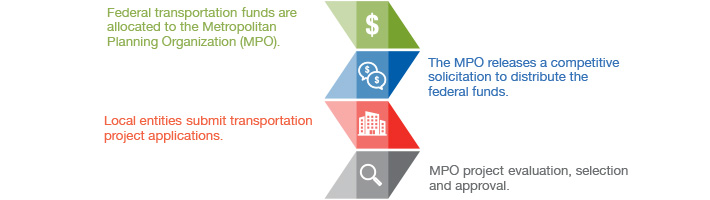
The Regional Solicitation happens once every two years and awards about $250 million in federal funds. The Transportation Advisory Board, comprising local elected officials and resident members, is central to the solicitation process.
While the board sets the expectations for the solicitation, scoring committees evaluate all project submissions. More than 60 technical experts volunteer their time over a two-month period. They provide their knowledge and experience on specific measures to score and recommend the most suitable regional projects to the board.
Projects improve connections and access
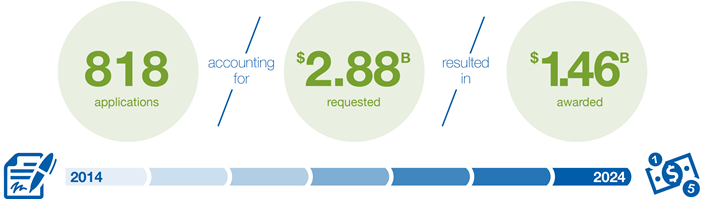
In 2024, the board granted $264 million in federal funding to 59 projects, and $19 million in Active Transportation funding through the regional transportation sales and use tax, adding 17 more projects. These projects are located across the region, in 52 cities and townships, and all 7 metro region counties. Some of this cycle’s funding highlights:
- Improving east to west transit from Sun Ray Transit Center in Saint Paul to downtown Minneapolis for the future METRO H Line bus rapid transit in the Como Avenue / Maryland Avenue corridor.
- Investing in 10 Safe Routes to School projects across the region that will help kids safely walk and bike to school.
- Expanding Metro micro services to Minnetonka, connecting to the METRO Green Line extension. Other new micro areas funded include Mendota Heights, Mendota, Lilydale, West Saint Paul, and Inver Grove Heights, connecting to the southern limit of the METRO G line at the Dakota County Northern Service Center.
- Reconstructing Robert Street in Saint Paul from the southern city limits at Annapolis Street E to Kellogg Boulevard.
- Constructing an interchange at Trunk Highway 65 and Bunker Lake Boulevard in Anoka County to improve safety and mobility.
Regional Solicitation process
Application categories:
Regional Solicitation
2026 federally funded application categories:
- Bridge connections
- Roadway modernization
- Congestion management strategies
- New interchanges
- Proactive safety
- Reactive safety
- Transit expansion (including microtransit)
- Transit customer experience
- Arterial bus rapid transit
- Regional bicycle facilities
- Travel demand management
Active Transportation Solicitation
2026 Regional Sales and Use Tax funded application categories:
- Local bicycle facilities
- Local pedestrian facilities
- Active Transportation Planning
Highway Safety Improvement Program Solicitation
2026 federally funded application categories (administered by MnDOT):
- Proactive safety
- Reactive safety
- Rumble-strip special program
Successful projects align with regional policies
Proposed projects must align with the goals of the region’s 2050 Transportation Policy Plan. The plan implements the core values, vision, and goals of Imagine 2050. Integrated with updates to regional plans guiding land use, water resources, housing, and parks policy, the Imagine 2050 family of plans will create a prosperous region for our children and grandchildren. Evaluation criteria are specific to the application categories.
Visit the Regional Solicitation background and evaluation processes page for more information on how the criteria were developed.